RCIID — blockchain forensics platform for court-grade crypto tracing
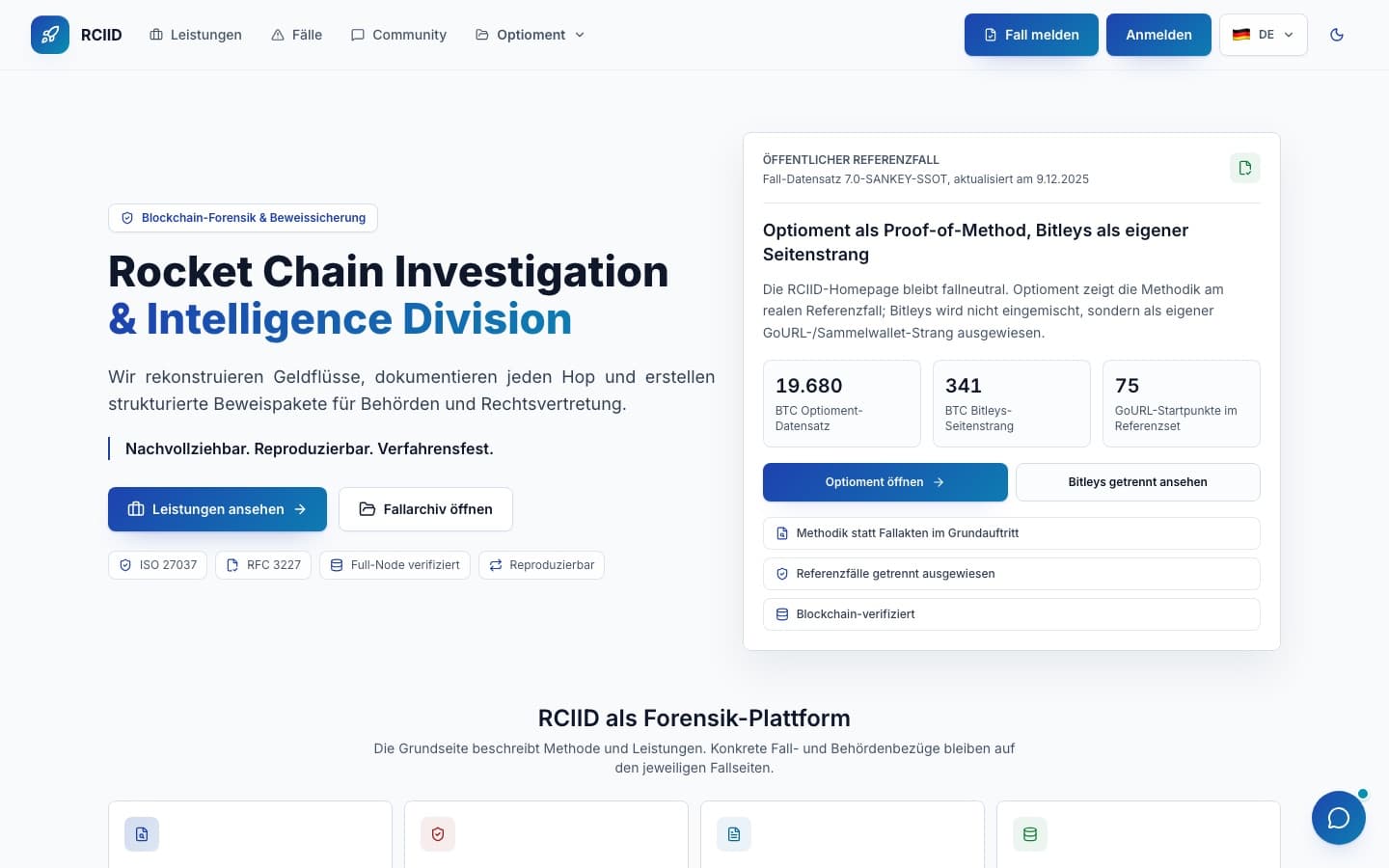
A platform for an Austrian blockchain forensics firm that presents crypto transaction tracing to lawyers, authorities and victims: methodology, Sankey money-flow visualisations, reference cases, structured reports, case submission and an authenticated member portal.
- Client
- RCIID
- Sector
- Blockchain forensics
- Region
- Austria
- Pillar
- Blockchain & Web3
The challenge
RCIID reconstructs crypto money flows for victims of fraud, their lawyers and authorities. Their work only has value if it holds up: every hop must be documented, every claim reproducible, and the presentation understandable for people who are not blockchain experts — judges, prosecutors, attorneys and victims.
The platform therefore had to do two things that pull in opposite directions: explain complex on-chain tracing in a clear, visual way, and at the same time meet the rigour expected from forensic evidence. It also had to support the firm's day-to-day work — taking in new cases, receiving tips and giving members a secure place to follow their cases.
Our approach
We started from the audience: a lawyer reading a report needs a different view than an investigator. We structured the platform around the forensic process — intake, tracing, attribution and reporting — so every page answers one question in that chain.
The presentation follows established forensic guidelines for handling digital evidence (ISO/IEC 27037 and RFC 3227): clear separation between methodology and individual cases, documented sources and transaction IDs, and reproducible analysis steps. Reference cases are shown separately from the general method pages, so the platform stays neutral while still proving the method on real data.
Money flows are the core of every case, so we made them visual. Sankey diagrams show how funds move from deposit addresses through intermediaries and mixers to endpoints such as exchanges — something a court can follow without reading hundreds of transaction hashes.
Solution & features
Tracing methodology
A clear presentation of how funds are traced from deposit through mixers and intermediaries to endpoints, including verification against the firm's own full nodes.
Sankey money-flow visualisations
Interactive visualisations that make complex multi-hop flows understandable for lawyers, authorities and victims.
Reference cases
Public reference cases that demonstrate the method on real data, kept strictly separate from the neutral method pages.
Structured CSV/PDF reporting
Reports and structured exports suitable for case files and legal submissions.
Case submission
A guided "report a case" flow that collects the information investigators need — transaction IDs, addresses, platform data and timelines.
Tip reporting
A dedicated channel for tips related to ongoing fraud cases.
Community forum
A space for affected people to exchange information and support each other.
Authenticated member portal
A secure, login-protected area for members and clients.
What this project demonstrates
- Deep understanding of on-chain data: addresses, transactions, mixers, clustering and exchange endpoints
- Turning complex technical evidence into visualisations non-experts can follow
- Building for rigour: forensic standards, reproducibility and a clean separation of method and case data
- Secure, authenticated platforms with intake workflows — the basis for our on-chain analytics work